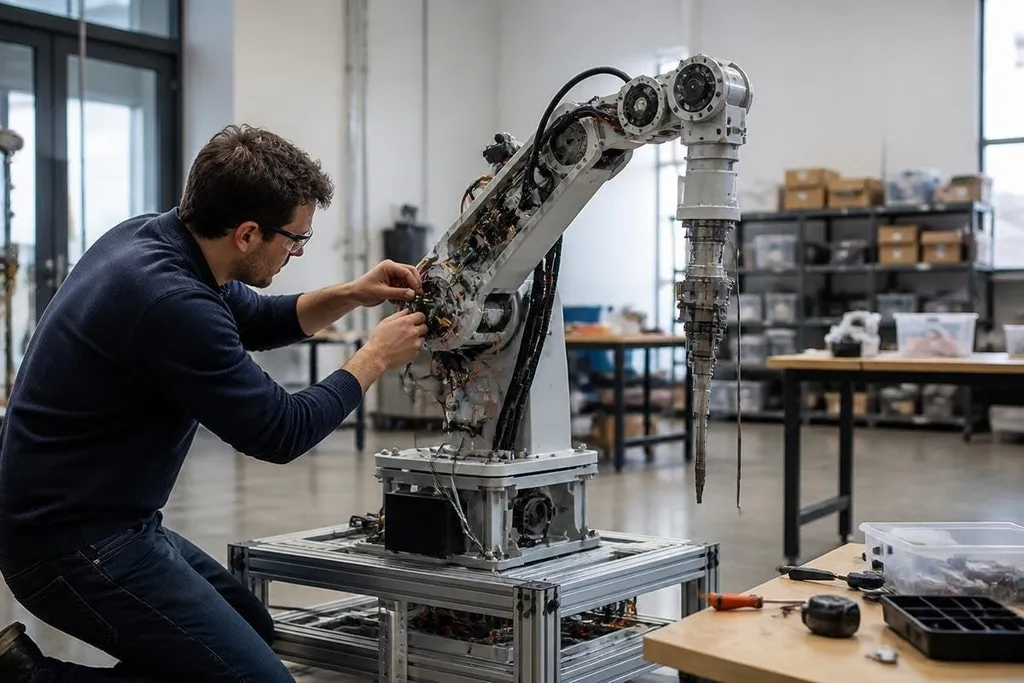
An open-source robot design can give more people access to the code, drawings, and control tools behind a machine. That may lower research costs and help companies repair or change robots without waiting for one supplier.
The hard part sits outside the software. A robot still needs safe hardware, repeatable parts, clear documentation, and someone to fix it when a motor fails.
Quick read
- Open code can speed up research and make repairs easier to inspect.
- Shared hardware files help only when parts can be made to the same dimensions.
- Factory buyers still need safety checks, support, training, and a clear cost plan.
What open source changes
A closed robot often ties the buyer to one maker’s control software, spare parts, and service team. An open-source robot can publish some or all of its code, mechanical files, electronics designs, or data so other people can inspect and change them.
That access matters when a research team needs a new gripper, a different camera, or a control routine for a task the maker did not plan for. The team can study the existing system and make a change without waiting for a product update.
The same model can help schools and small labs. Students can see how a motor command moves through the control stack, while researchers can compare results on the same design. Shared files also make it easier to find a design fault because more people can inspect the work.
A shared design does not mean every part is free. Motors, batteries, sensors, machined parts, safety hardware, and assembly time still cost money. A free design with hard-to-find parts may cost more to build than a supported commercial robot.
Hardware sets the limit
Software can be copied quickly. Robot hardware cannot.
A useful open design needs a full parts list, drawings with tolerances, wiring details, firmware, and clear assembly steps.
Tolerance means the allowed difference between the target size and the part that gets made. A hole that is 0.5 mm off can affect a bearing, belt, or joint.
Parts also need steady supply. If a motor disappears from the market, the design may need a new bracket, new wiring, and new control settings. That work can erase the time saved by starting with shared files.
The design must also state what the robot can safely carry and how fast it can move. A gripper that lifts 2 kg in a lab may behave differently after thousands of cycles in a factory.
Buyers need test results that show how the robot handles wear, heat, dust, and power loss.
Safety and support decide adoption
A factory cannot treat a robot’s public code as proof that the system is safe. Engineers still need to check the finished machine, its sensors, its limits, and its behavior near people.
Open code can help that check because the control logic is available for review. It can also create extra work. A change to motion control may affect force limits, emergency stops, or the way the robot reacts to a lost sensor.
Support matters after installation. A buyer needs wiring diagrams, replacement part numbers, software updates, and a clear way to report faults. A community may answer some questions, but a production site may need a named team and a response time.
An open-source robot may avoid a software license fee, but your team still pays for testing, repairs, and support. Reports from Robot 24 can give you named machines and companies to compare with that workload before the business case moves to price.
The business case is still specific
These robots may fit research, education, custom automation, and small production tasks. They make less sense when a buyer needs one supplier to take responsibility for the full system.
The financial test should include the build cost, engineering time, safety work, training, repairs, and lost production during faults. A lower purchase price can disappear if the buyer must spend weeks adapting the design.
I’d back open-source robots first in places where people can change the machine and have the staff to maintain it. That is a narrower market than the phrase suggests, but it is a real one.
A buyer’s decision checklist
Use these checks before choosing an open design:
- Code access: Can your team read, change, and build the control software?
- Part supply: Are the motors, sensors, batteries, and bearings available from more than one source?
- Build records: Do the files include drawings, wiring diagrams, tolerances, and revision history?
- Safety work: Who will test emergency stops, force limits, guarding, and sensor faults?
- Repair plan: Can a technician replace a failed part without waiting for the original maker?
- Total cost: Have you counted engineering hours, training, testing, and downtime?
Shared robot designs can change the industry where they remove real work and local teams can support the result. The next proof will come from machines that run repeated jobs, with published limits and repair records, rather than from code alone.